
Why Amazon Sellers Should Stop Using the Main Account as Their Daily Seller Central Login
Quick takeaway: If your main Amazon account is also your daily Seller Central login, you are creating unnecessary risk. The safer structure is to separate personal buying, business-side buying where genuinely needed, and day-to-day Seller Central access through a separate admin user-permission login.
More and more sellers are losing access to Seller Central even though the real issue did not start inside the seller account itself.
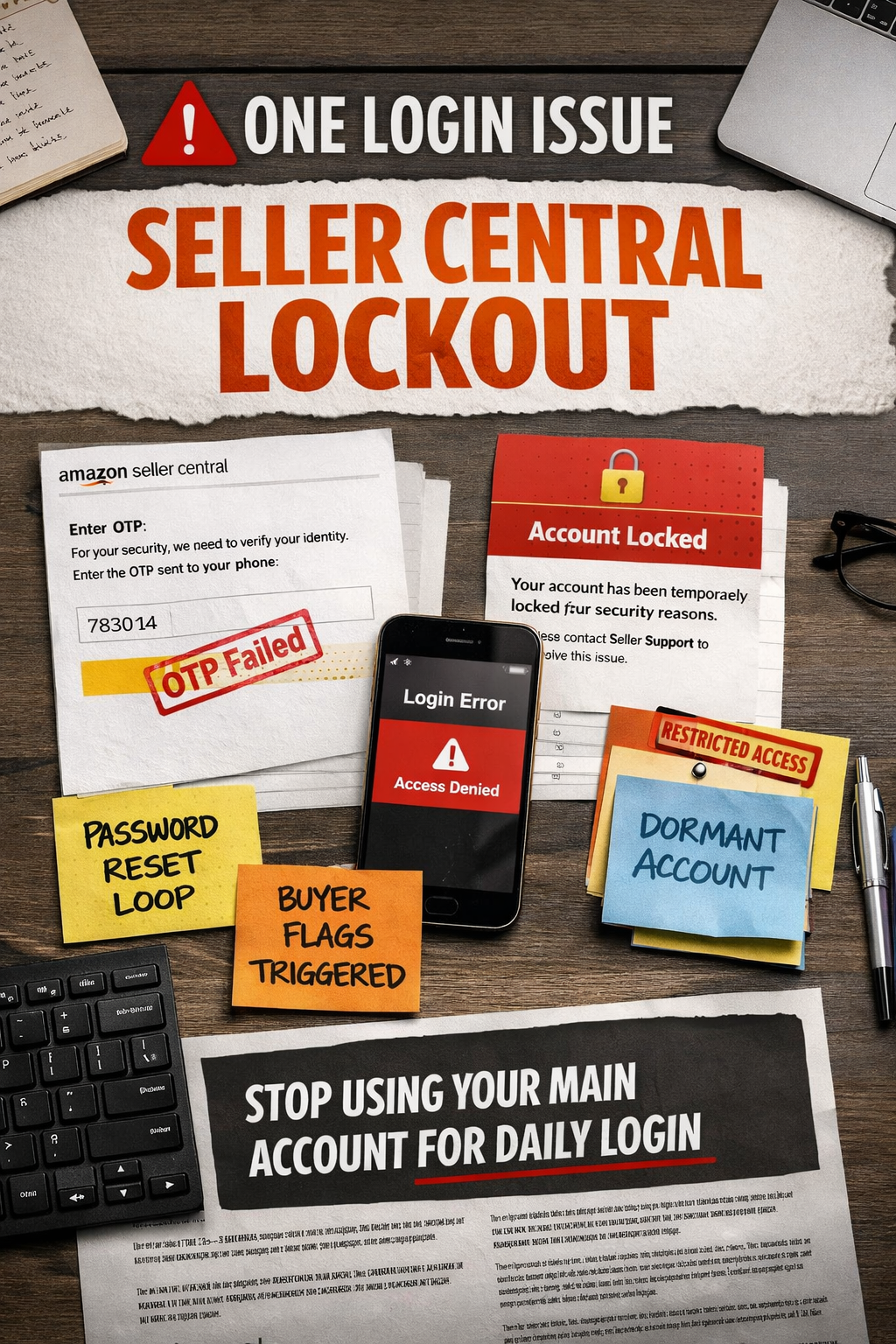
The account appears locked. OTP codes stop arriving. The login gets blocked. Amazon shows a buyer-side restriction, a security warning, a business account issue, or a general access problem that does not look like a standard seller performance enforcement. The seller then assumes Seller Central itself was restricted, when in many cases the real issue is sitting on the main login behind it.
This is where many sellers get caught. They use the primary Amazon account as their everyday Seller Central login. Once that login is interrupted for any reason, access to Seller Central can go down with it.
The better structure is simple. Your main account should not be your daily working login.
The Real Problem Is the Login Layer
When sellers get locked out, they often assume this is a seller enforcement. Sometimes it is. But in many cases, the issue sits at the access layer instead.
The main account may be affected by OTP delivery failure, buyer account restrictions, Amazon Business account concerns, suspicious login alerts, password reset loops, dormant-account friction, or identity verification issues. Once that happens, Seller Central becomes inaccessible because the seller is trying to enter through the same credentials that were affected.
That is why some sellers suddenly lose access even though there is no classic seller suspension in place.
Why This Happens So Often
Amazon does not always separate account functions in the clean way sellers assume it does. A single account can end up carrying multiple roles at once.
It may be the main buyer account. It may be tied to a business buying profile. It may be the primary Seller Central login. It may be the account receiving OTPs and password resets. It may also be the account Amazon treats as the highest-security login point.
That means one issue at the account-access level can create a chain reaction across everything attached to it.
The Smarter Access Structure
The safest setup is to separate account functions instead of combining everything under one login.
| Account Type | Use It For | Do Not Use It For |
|---|---|---|
| Personal buyer account | Personal Amazon purchases only | Seller Central access, business buying, operational account work |
| Business-side buyer account | Limited operational purchases where genuinely needed, such as internal sample buying or market testing | Personal shopping, daily Seller Central login, mixed-use activity |
| Admin user-permission login | Day-to-day Seller Central access and routine account management | Buyer activity, personal orders, unrelated Amazon activity |
| Main primary account | High-sensitivity actions only, such as bank changes, legal entity updates, ownership updates, tax changes, and other major account-level settings | Daily Seller Central use, routine staff activity, mixed buyer activity |
This structure reduces the chance that a buyer-side issue, OTP problem, business-account restriction, or security hold will disrupt access to Seller Central.
Why a Separate User-Permission Login Matters
A separate admin user-permission login reduces risk in several directions at once.
First, it reduces exposure to buyer-side problems. If your daily Seller Central access is tied to an account with no buyer activity, there is simply less chance that personal ordering issues, buyer restrictions, return-related friction, or unrelated account reviews will interfere with seller access.
Second, it helps with security events. If Amazon temporarily locks the primary account because of suspicious activity, OTP irregularities, or access anomalies, your user-permission login may still remain accessible.
Third, it creates a cleaner operating structure for internal teams. That matters not only for access continuity, but also for control, accountability, and reducing unnecessary activity on the main login.
What Sellers Keep Getting Wrong
The most common mistake is using the primary account for everything. They buy personal items from it, log into Seller Central from it every day, use it for password resets and OTP delivery, and sometimes connect it to broader business-account activity too. Then one issue appears and the whole structure becomes unstable.
Another common mistake is waiting until there is already a lockout before creating a safer access structure. Prevention is easier than recovery.
A third mistake is assuming this is only about OTP problems. It is not. OTP issues are just one visible symptom. The broader issue is that the main login is too exposed.
Important Caution
This is not about creating messy or uncontrolled account structures. Access should remain properly authorized, limited to legitimate business users, and managed inside Seller Central through the correct user-permission framework.
The goal is not more complexity. The goal is cleaner separation between personal buying, business-side buying where needed, and seller account access.
What To Do If You Are Already Locked Out
If you are already in the middle of this problem, the first step is usually not Seller Central.
In many cases, the path starts from the buyer side. That may mean restoring access to the buyer account, resolving the security or business-account restriction, resetting password or OTP methods, or completing the identity verification steps Amazon requires for the main login.
If you have already covered the recovery path in another article, this is the right place to link to it. The access issue often needs to be resolved before Seller Central access can fully return.
But once access is restored, sellers should not go back to the same weak structure that caused the problem in the first place.
The Better Long-Term Habit
Treat your main account like a high-risk control point, not like your everyday work login.
Use a separate admin user-permission account for daily Seller Central access. Keep personal buying completely separate. Keep any seller-related purchasing activity limited, intentional, and isolated from the login you use to run the account.
This will not eliminate every access problem. But it removes one of the most common and most avoidable reasons sellers get dragged into unnecessary lockouts.
Already locked out? Fix access first, then fix the structure. If the issue sits on the buyer-side login, OTP path, or main account credentials, solving that layer usually comes before Seller Central access can fully return.
Final Thought
A lot of sellers think account access problems are random. Many are not. They are structural.
The way you set up access matters. The way you separate buyer activity from seller operations matters. And the login you choose to use every day matters more than most sellers realize.
If you want to avoid losing access to Seller Central over an issue that began somewhere else, fix the structure before the problem starts.