Amazon Review Sharing Changes: Check Your Variation Family

Amazon Sellers Appeal, operated by ASA Compliance Group and led by Or Shamosh, has reinstated 5,600+* Amazon seller accounts and ASINs since 2016.
We handle account suspensions, listing appeals and compliance cases, from the first review through submissions and follow‑ups.
Updated .
Check review-sharing eligibility separately from variation validity
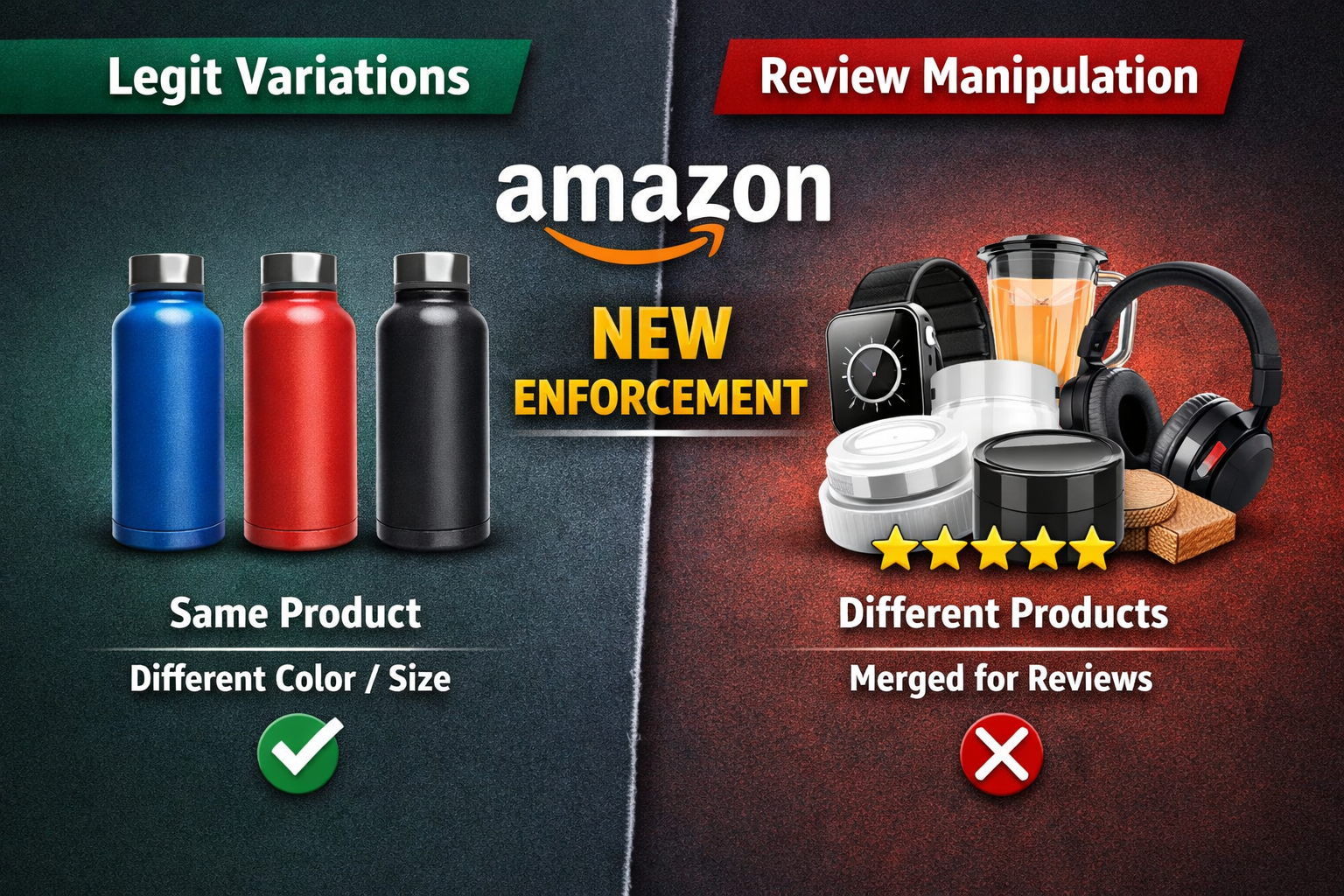
A valid Amazon variation family can still have products that are not eligible to share reviews. Check the differences between the child ASINs against Amazon’s review-sharing criteria, then distinguish an eligibility change from a catalog error or a review-manipulation allegation. A change in review count alone does not prove misconduct.
What the 2026 update actually changed
Amazon announced a category-by-category rollout from February 12 to May 31, 2026. Those dates have passed. The change limits shared reviews to eligible minor product differences that do not affect functionality. See Amazon’s announcement and the current review-sharing guidelines.
An old screenshot of a combined count does not establish the current eligibility of every child ASIN. Preserve it as part of the listing history, alongside the product details and any message Amazon sent.
How to investigate a review-count change
- Save the identifiers. Record the marketplace, parent and child ASINs, variation theme, review counts, star ratings, and date observed. Use product-specific URLs and screenshots.
- Check each child directly. Distinguish the count displayed on the selected product from reviews visible after filtering by variant. A parent-level comparison can hide what changed.
- Check catalog changes. Look for a recent merge, split, product-type change, attribute update, or other contribution. Preserve the previous mapping and processing reports if you have them.
- Compare product differences. Describe the actual feature, formulation, fitment, function, or quantity difference. Do not change an attribute to make products appear more similar than they are.
- Choose the relevant route. Correct a documented catalog error through the listing workflow. For an apparent review-display error, submit a focused support case with the eligibility basis and examples.
Which product differences can still share reviews?
Amazon’s announced examples include:
- Color or pattern differences in the same product.
- Sizes that keep the same function.
- Pack quantities.
- Secondary scents where scent is not the product’s main purpose.
- Different fitments within the same product type.
Apply the criteria to the actual product differences and category. These examples do not guarantee that every valid variation family keeps its previous review count.
Amazon’s later clarification explains that eligibility depends on the variation theme attribute. For example, a family using flavor and size may share reviews for size differences while flavor differences do not qualify. Check that the theme accurately describes the products.
Catalog changes worth checking separately
Review the history if an ASIN was merged, a discontinued product was replaced, separate products were grouped under a parent, or bundle contents changed. Record the product identifiers, actual differences and dates before deciding whether a catalog correction is needed. A completed merge does not by itself establish review-sharing eligibility.
Where Amazon identifies a variation-policy issue, answer that specific finding. Where only the displayed review count changed, first investigate eligibility and the listing history. Avoid changing attributes or combining products solely to recover a previous count.
What about Vine reviews?
Amazon’s Vine clarification says that, where products no longer qualify for sharing, Vine reviews return to the original child ASINs when applicable, subject to Vine limits and review-policy compliance. This is not a promise that every missing review returns or that merging enrollments adds their counts together.
Keep the original enrollment details, child ASINs and merge history. Check the applicable Vine rules before making a program-specific change; a review-count drop alone does not establish Vine abuse.
Choose the next step from the evidence
- Eligibility changed: compare the specific children and theme with the current criteria. Do not assume the former combined count should be restored.
- A catalog error is documented: preserve the previous mapping and correction evidence, then use the relevant listing workflow.
- A display error is suspected: provide product-specific URLs, dated screenshots and the eligibility basis in a focused support case.
- Amazon issued an enforcement message: address the cited issue and requested evidence. Use a supported dispute or corrective response as the facts require.
For an affected ASIN, our listing reinstatement service reviews the case record and explains the proposed work. Variation-abuse appeal support is relevant when the issue concerns the catalog relationship or an enforcement allegation.
A variation change affected your listing?
Share the affected parent and child ASINs, the catalog change and any related Amazon message. We can assess the evidence and explain the scope and fee for handling the Amazon case.