Amazon’s Review Sharing Update (Jan 7, 2026)
Amazon’s Review Sharing Update (Jan 7, 2026)
This Is Not About Legit Variations. It’s About Enforcing Against Review Engineering.
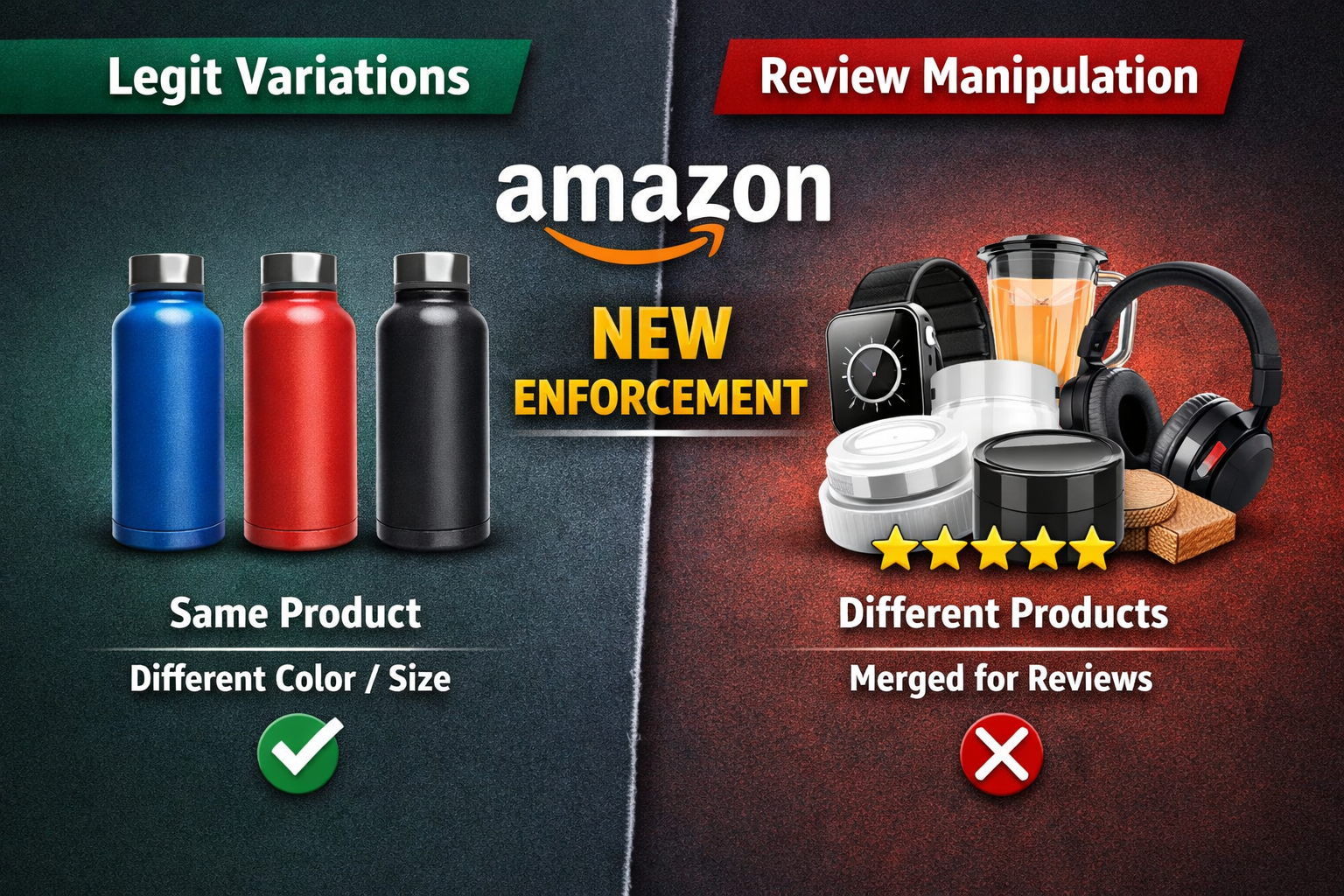
On January 7, 2026, Amazon published an update in Seller Central announcing changes to how reviews are shared across product variations.
The rollout begins on February 12, 2026, continues through May 31, 2026, and is applied by category, with sellers receiving advance notice before their listings are affected.
Official announcement: https://sellercentral.amazon.com/seller-news/articles/QVRWUERLSUtYMERFUiNHNzQzV0JEN0RBN1pQNFFR
Referenced policy – Review Sharing Guidelines: https://sellercentral.amazon.com/help/hub/reference/G74DLBUEHT5GY88C
Since the announcement, many posts and messages have framed this as a broad threat to sellers, warning about lost reviews, broken parents, and collapsing variations.
That framing is incorrect.
This update is not about valid variations.
It is not about Amazon cracking down on clean catalogs.
And it is not something most sellers need to panic about.
This update is about enforcing against review transfer and review aggregation tactics that sellers have been using for years.
If your variations are legitimate, this update should not worry you
Let’s be clear from the start.
If your variations represent:
- The same product
- The same performance
- The same experience
- With differences limited to color, size (where function doesn’t change), quantity, or fitment
Then there is no reason for concern.
Amazon explicitly confirms that these variations continue to share reviews.
This update does not target:
- Proper color variations
- Legit size variations where function is unchanged
- Pack size or quantity variations
- Normal fitment differences (for example, phone cases for different models)
If your catalog is clean, nothing breaks.
What this update is actually enforcing against
The enforcement is aimed at sellers who used variations, merges, and Vine to manufacture shared reviews across different products.
These behaviors were never “best practices”.
They were tolerated loopholes.
Amazon has been tightening around them for years.
This update is where review sharing finally catches up.
Below are the specific methods this update is designed to shut down.
Method 1: Merging discontinued ASINs to transfer reviews
This is one of the oldest patterns Amazon has tolerated and is now closing.
The typical flow looked like this:
- Product A launches and accumulates reviews
- Product A is discontinued or quietly replaced
- Product B is introduced as a “new version”
- Product A is merged into Product B so the reviews carry over
From the seller’s perspective, this felt reasonable.
From Amazon’s perspective, it breaks review attribution.
Reviews written for Product A now appear on Product B, even though the customer never bought Product B.
Under the new logic, this is no longer acceptable.
Different model or generation = different experience = reviews should not transfer.
Method 2: Creating multiple separate products, then merging them into one parent
Another common tactic:
- Launch several similar but not identical products as separate ASINs
- Let each one collect reviews independently
- Merge them later under a single parent to pool reviews
Sometimes the differences were:
- Material
- Power
- Design
- Function
- Bundle contents
As long as Amazon allowed the merge, reviews flowed.
The new policy explicitly blocks this.
If the differences affect experience, performance, or value, reviews stay isolated – even if the variation relationship technically exists.
Method 3: Vine review seeding followed by post-Vine merges
This is one of the most misunderstood and abused tactics, and it directly ties into Amazon’s prior Vine clarifications.
The flow usually looked like this:
- Launch a new ASIN with a minor difference
- Enroll it in Vine and collect 20–30 Vine reviews
- Launch another ASIN (or use an existing parent)
- Merge the Vine ASIN into the main listing so reviews appear at the parent level
On paper, sellers believed this was valid because:
- Vine reviews are legitimate
- The ASINs were technically mergeable
Amazon later clarified that:
- Vine reviews are aggregated at the parent level
- Vine review counts are capped
- Post-Vine merging does not result in cumulative Vine reviews
- Excess Vine reviews may be dropped
- Patterns of Vine review shifting can trigger enforcement
This review-sharing update reinforces that position.
Using Vine on disposable or temporary ASINs with the intent to merge later is now clearly treated as review manipulation, regardless of intent.
Method 4: Bundles and value masking
Another frequent pattern:
- Sell a standalone product
- Create a bundle (product + accessories)
- Merge them so the bundle inherits reviews
Amazon now explicitly states that bundles and standalone products should not share reviews.
The value proposition is different.
The experience is different.
The reviews should not mix.
This update removes any remaining gray area here.
Why Amazon has been moving this way for years
This change didn’t appear suddenly.
Over time, Amazon has systematically tightened control over:
- Incentivized reviews
- Review manipulation
- Vine abuse
- Variation merges
- ASIN history and lineage
- Listing changes that alter product reality
Each step served the same purpose:
Prevent old trust signals from being reused to sell a different experience.
Reviews today are not just conversion tools.
They are:
- Trust infrastructure
- Inputs into ranking and recommendation systems
- Signals used to reduce returns
- Data with legal and regulatory implications
When reviews don’t match what customers receive, Amazon absorbs the cost.
This update reduces that cost.
The actual rule Amazon is enforcing now
From the updated Review Sharing Guidelines:
“Reviews will only be shared when product variations have minor differences that don’t impact a product’s core functionality.”
That’s the entire rule.
Amazon is no longer asking whether products are related.
Amazon is asking whether the experience is the same.
If it is, reviews can be shared.
If it isn’t, they can’t.
Why fear is being spread – and why it’s misplaced
Fear is coming from sellers and agencies who:
- Built growth strategies around review aggregation
- Relied on merges to prop up weaker ASINs
- Used Vine as a review transfer tool
For those sellers, this update hurts.
For sellers with legitimate variation structures, it does not.
Saying “everyone should panic” is inaccurate and misleading.
The correct takeaway is simple:
If your reviews reflect the product customers actually receive, nothing changes.
Rollout mechanics (important context)
- Rollout starts: February 12, 2026
- Rollout ends: May 31, 2026
- Applied by category
- Sellers receive advance notice
This gives sellers time to correct structure before Amazon enforces automatically.
What sellers should do now
No panic. Just clarity.
- Audit parent ASINs honestly. Would a customer expect the same experience across all children?
- Identify review engineering patterns. Discontinued merges, Vine seeding, bundle masking, formulation changes.
- Fix stretched structures proactively. Controlled review loss now is better than forced separation later.
- Stop treating reviews as transferable assets. Amazon clearly no longer does.
One line that makes Amazon’s intent obvious
Amazon states:
“If you have to update your variation themes after the change takes effect, reviews will be re-shared for eligible products.”
This tells you everything:
- Amazon wants correct structure
- Not punishment
- Not fear
- Alignment
Bottom line
This update is not about valid variations.
It is about enforcing against:
- Review transfer
- Review laundering
- Artificial review aggregation
Amazon has been closing these paths for years.
Review sharing is simply the last piece to fall in line.
If your catalog is clean, this is a non-event.
If it isn’t, Amazon is drawing the line.
Fear helps no one here.
Understanding does.