
Suspected Amazon Safety Complaint Abuse: Evidence

Address the safety issue Amazon raised and preserve evidence of any suspected abuse as a separate factual record. Compare complaint patterns, orders, product tests, and correspondence before drawing conclusions about the source.
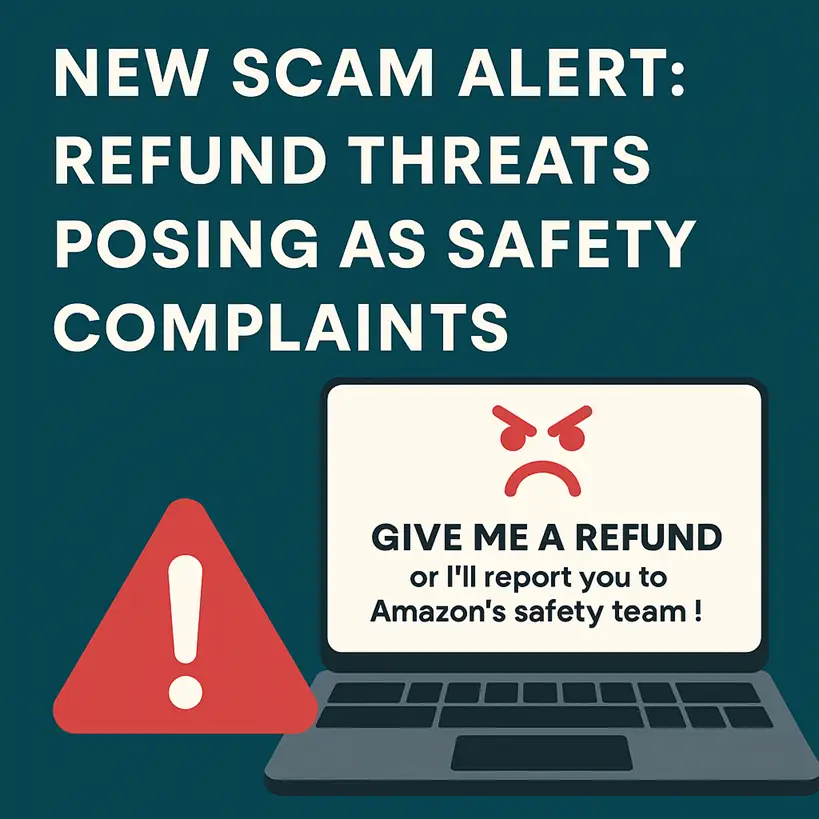
Refund threats disguised as safety complaints.
These messages don’t come from the usual angry customers. They come in with calm, calculated language – usually copy-pasted across multiple buyer accounts – and are designed to do one thing: trigger Amazon’s internal safety protocols without ever needing to provide proof.
What It Looks Like
These messages typically follow a specific structure:
“I will not provide proof. I will escalate this to Amazon’s Safety Team. I expect a full refund immediately, no conditions. This is your only chance to avoid escalation.”
Sellers have shown us near-identical messages arriving from different buyer accounts within days of each other. Compare the order references, wording, timing and any information actually available to you. Sellers generally cannot see buyers’ private IP addresses, and a shared region alone does not establish coordination.
They all have the same demands:
- No return
- No evidence
- Full refund now
And the result? If Amazon sees multiple unresolved complaints that mention safety or product condition issues, their system flags the ASIN – or the account – automatically.
What Happens Next
These cases can escalate quickly:
- Listings get deactivated.
- FBA inventory is frozen.
- Sellers are left with no warning – and no clear path to reverse it.
The most dangerous part? Amazon treats these as legitimate safety concerns unless you act strategically. The burden falls on the seller to show that something doesn’t add up – and to document it before the system acts.
What You Should NOT Do
This is where most sellers make costly mistakes. Don’t fall into these traps:
- DO NOT engage emotionally. Don’t debate the buyer or use words like “dangerous” or “hazardous.” That can backfire.
- Follow the applicable refund and return process. Do not impose a blanket return-first rule on every safety complaint. For FBA orders, use Amazon’s process. Preserve the demand and report suspected abuse separately from the buyer’s refund rights and the product-safety investigation.
What You SHOULD Do
- DO use Amazon’s “Report Message” tool to flag each incident. It won’t solve the issue – but it will leave a breadcrumb trail that Amazon can reference later.
- DO open a proactive case with Amazon. Ask them to add an internal annotation noting that you’ve received copy-pasted messages alleging safety concerns. Make it clear you are not requesting enforcement – just documentation in case of escalation.
Why This Matters
Amazon’s system doesn’t evaluate intent. It reacts to keywords, complaint frequency, and risk triggers. If enough “safety” messages land against your ASIN in a short period of time, you’re guilty until proven compliant.
But if you’ve documented the abuse early – and done it calmly and strategically – you give Amazon an alternative story to recognize.
That’s the goal. Not escalation. Not panic. Just: strategy.
If this hasn’t happened to you yet, good. Save this article.
If it has – you know exactly how fast it can spiral.
And if you need help framing the right annotation message or replies? We’ve written hundreds. We know how to get Amazon to take it seriously – without pushing the wrong buttons.
Start with the product and the incident
Record the product, order, batch or serial number where available, alleged fault, and any injury or damage described. Preserve the original message and ask factual questions through the permitted support channel. Do not coach the customer’s account of events or ask them to withdraw a safety report.
If the information suggests a real hazard, involve the person responsible for product safety and assess what action is required. For U.S. consumer products, CPSC’s business reporting guidance explains when reporting obligations can arise. Do not wait for Amazon’s abuse investigation before addressing a potential hazard.
Prepare a factual report for Amazon
Use the reporting option available in Seller Central or on the relevant message. Amazon’s reporting guidance describes reporting policy violations with supporting information.
- Identify the affected ASINs, orders, and marketplace.
- Include the complete messages, dates, and case references.
- Describe the suspected behavior without exaggerating intent.
- Provide the relevant product investigation separately, including any unresolved issue.
- Ask Amazon to review the evidence and identify any further information needed.
An internal note or submitted report is not a guarantee that future complaints will be ignored or that a listing will remain active.
Compare incidents without losing the original evidence
Build one row per incident. Include the order ID, ASIN, date of delivery, date and exact wording of the message, claimed problem, requested remedy, return status and any Amazon case reference. Add a link or filename for the original message. Keep buyer information within the people handling the case rather than publishing it.
The strongest patterns are specific and verifiable. Identical unusual wording, repeated deadlines, a shared demand outside the normal refund process, or contradictions between the message and order history are useful observations. A similar complaint from two customers can also have an ordinary explanation, including a real product defect. Record both possibilities while the evidence is reviewed.
Example: three similar messages after one delivery batch
A fictional seller receives three messages using the same unusual sentence and demanding a refund without a return. The timing suggests possible copying. However, all three orders also contain stock from the same batch.
The seller preserves the messages and reports the suspected pattern, while separately inspecting retained stock and investigating the alleged fault. If the batch has a genuine problem, that finding must shape the safety response even if the refund demands appear coordinated. Treating the two questions separately gives Amazon a more useful record.
A report structure you can adapt
Use the actual reporting route shown in your account. Replace every bracket below with a verifiable detail, remove anything you cannot support, and attach the complete messages. Keep a submitted copy and the confirmation or case number.
Subject: Request to review suspected coordinated message abuse affecting [ASIN] in [marketplace]
We received [number] messages on [dates] linked to orders [references]. The messages repeat [specific wording or demand]. We have attached the originals and a chronological comparison.
Our concern is [observable behavior]. We are asking Amazon to review whether it violates the applicable policy. We have not established who controls the buyer accounts.
Separately, we investigated the reported product issue by [actions taken]. The current findings are [facts], and [outstanding question] remains under review. We are following the required safety and refund process.
Please review the attached evidence alongside cases [references] and advise if further records are needed.
If the ASIN is deactivated anyway
Answer the enforcement notice on its own terms. Identify the product, address the stated safety concern and supply the requested evidence. Include the abuse report reference where it is relevant, but do not make “a competitor did this” the whole appeal. Amazon still needs to understand the product and what you found.
Where repeated complaints follow earlier successful appeals, keep a dated list of the notices, decisions and subsequent incidents. Explain what is repeated and what is new. This gives the reviewer a chronology instead of another isolated allegation.
A saved report is useful evidence of what you raised and when. It does not establish that Amazon investigated, accepted your theory or exempted the ASIN from future safety checks. Continue monitoring both the product issue and the reporting case until each has a clear outcome.
Safety complaints have led to a restriction?
Tell us what Amazon actioned, the product investigation status and the records supporting any suspected abuse. We can assess both parts of the response and explain the scope of case support.