
Amazon Button Cell Battery Compliance and CR2032

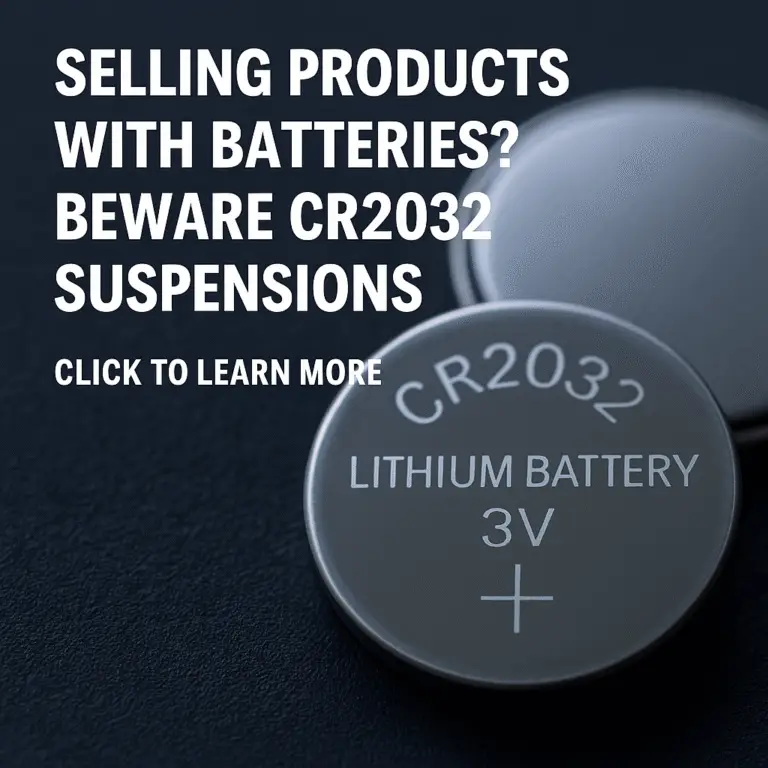
Identify the battery-containing product and the requirement cited in the Amazon notice. Compare the test records, compartment design, packaging, warnings, and product identifiers before organizing the compliance response.
A listing can be removed even when the seller has a compliance folder ready. One notice we have encountered states:
This product causes a safety risk. We will not be reviewing any documents for this ASIN.”
The email offers no path for appeal. Your inventory becomes stranded. Your compliance folder sits untouched. You’re locked out with no explanation, and no amount of support tickets will get it reopened.
For a seller using CR2032 coin cells, the practical task is to establish which safety requirement caused the restriction and whether the current product, packaging and documents meet it.
What Is a CR2032 – and Why Amazon Cares So Much
A CR2032 is a 3-volt lithium manganese dioxide coin cell battery. It’s roughly the size of a nickel: 20mm in diameter and 3.2mm thick. You’ll find it in thousands of common consumer devices – key fobs, pet trackers, glucose meters, kitchen thermometers, laser pointers, scales, and wearable tech.
It’s small, cheap, reliable – and also dangerous. Not because of what it does, but because of what can happen if a child swallows one.
When swallowed, a CR2032 can become lodged in the esophagus and cause internal tissue burns, bleeding, or death in under 2 hours. This risk isn’t hypothetical. It has been documented repeatedly by emergency medicine departments around the world.
That’s why the U.S. Congress passed Reese’s Law in 2022, which required the Consumer Product Safety Commission (CPSC) to adopt stricter regulations for products containing button or coin cell batteries.
As of March 2024, those rules – codified under 16 CFR Part 1263 – are in full effect. Amazon is now enforcing them at scale. If your product listing has been flagged or removed due to these regulations, you may need to file an Amazon product safety complaint appeal to have your listing reinstated. Understanding how to navigate the product safety issue Amazon appeal process is crucial for sellers whose products contain CR2032 batteries or similar components, as compliance with these safety standards is now mandatory for marketplace participation.
The Core of Compliance: UL 4200A and 16 CFR 1263
To comply with Reese’s Law, products containing coin batteries must meet the design and labeling requirements set forth in ANSI/UL 4200A. This standard includes:
Battery Compartment Security
The battery must be inaccessible to a child during normal or foreseeable use.
Battery enclosures must either:
Require a tool (e.g., screwdriver) to open, or
Require two independent, simultaneous actions (e.g., push and slide).
Abuse Testing
UL 4200A includes a set of rigorous physical tests to simulate child misuse:
- The laboratory should document the applicable use-and-abuse testing and whether the battery remains inaccessible. Use the actual standard and product test plan rather than treating a simplified online list as the test specification.
These tests are not theoretical. If your battery door fails just one of them, your product is considered non-compliant.
Warning Label Requirements
The packaging must include:
The word “WARNING” in bold, capital letters
A safety icon (exclamation triangle)
- Use the prescribed ingestion-hazard warning, not an improvised substitute. Confirm the exact wording and layout against the applicable CPSC rule.
Placement must be on the principal display panel, not hidden in small print
Different provisions have different effective dates and scopes. Check the applicable product and battery requirements in CPSC’s button-cell guidance, including product warnings, battery packaging and any applicable exemptions.
The Compliance Chain: Where Sellers Fail
Amazon’s ingestion hazard enforcement is largely automated, and it doesn’t take a visible complaint to trigger a takedown. In fact, most CR2032-related listing removals result from metadata mismatches, undeclared components, or insufficient documentation.
Here are the most common causes of listing shutdowns:
1. Missing Backend Declaration
An undeclared or incorrectly described battery creates a mismatch between the physical unit, packaging and catalog record. Correct it accurately, then establish whether Amazon’s restriction also concerns the compartment, warnings, test evidence or other physical requirements.
2. Incorrect Battery Type
Many sellers mistakenly list the battery type as CR2 (a cylindrical battery) instead of CR2032 (a coin cell). This isn’t a small mistake. Amazon treats it as an integrity issue. If your packaging says CR2032 and your backend says CR2, you’ve created a data mismatch that triggers ingestion hazard review.
3. No UL 4200A Documentation Submitted
UL 4200A is now the accepted baseline for coin battery safety. Amazon expects a full test report from an ISO 17025 lab. If that report is missing, outdated, or too vague (e.g., doesn’t specify the product SKU), the listing may be suspended, even without a customer complaint.
4. Lack of a GCC (General Certificate of Conformity)
Where required, a General Certificate of Conformity supports a general-use product. Children’s products use a Children’s Product Certificate and applicable testing requirements. Confirm the correct certificate, rule references, manufacturer or importer and product identification; a lab report and certificate serve different purposes.
5. No Warning Label on Packaging
If your packaging doesn’t visibly show the required ingestion hazard warning, Amazon may reject your documentation outright – even if your product passes all tests. Visual evidence is often required.
6. Loose Spare Battery
If your product ships with an extra CR2032 and it’s not in child-resistant packaging, your listing is non-compliant. Spare batteries must be sealed in blister packaging or a safety-tested single-release pack. Loose coin cells are a regulatory red flag.
What Amazon Expects – Even if They Don’t Tell You
Amazon rarely gives sellers step-by-step guidance on compliance. But after analyzing dozens of ingestion hazard removals and reversals, we’ve identified the standard Amazon silently enforces.
What to Declare in Seller Central
-
Battery Type: CR2032
-
Battery Chemistry: Lithium metal
-
Battery Count: (e.g., 1 or 2)
-
Battery Weight: ~3g per battery
-
Battery Placement: Contained in equipment
What to Upload to Compliance Portal
-
UL 4200A test report (must reference product ID and battery type)
-
Signed GCC listing:
-
Manufacturer/importer
-
Product name + ASIN
-
Test standard (UL 4200A / 16 CFR Part 1263)
-
Lab name + date
-
Signature + date
-
-
Photo of packaging showing warning label
-
Battery SDS (optional, but useful for hazmat clearance)
If You’re Already Flagged
If Amazon has already removed your listing with a message like:
This product causes a safety risk. We will not be reviewing any documents.”
That wording indicates a serious restriction with a limited response route. Review the actual reason and available appeal options. A corrected battery attribute alone cannot resolve a physical safety problem.
-
You correct the backend battery declaration
-
You resubmit a complete, aligned package
- Explain the actual finding, product condition and completed correction. Call it a data error only if the evidence supports that conclusion.
Example appeal positioning:
“After reviewing our internal product registration, we discovered the battery was previously misclassified in Seller Central. The product does include a CR2032, and we’ve now corrected this. Attached are our UL 4200A test results, our General Certificate of Conformity, and a product image showing proper battery warnings and security features. We respectfully request reconsideration based on this correction and our compliance with all relevant safety requirements.”
If your backend says CR2, but the label says CR2032 – you’re blocked. If your backend says nothing about batteries, but your packaging clearly contains one – you’re blocked.
Review the physical product, test evidence, warnings and catalog data together. Correct the actual issue before appealing.
Check the product and the evidence together
An ingestion hazard can arise from an unsafe compartment or failed testing as well as missing warnings or inaccurate listing data. Treat the physical design and the documents as equally important parts of the review.
A battery that becomes accessible during foreseeable use can indicate a real design failure. Accurate paperwork cannot make that product safe.
So if your product includes a CR2032:
-
Don’t hide it
-
Don’t mislabel it
-
Don’t skip the warning
-
Don’t assume that “working fine” means “compliant”
Because when the ingestion risk is real, silence gets punished harder than error.
A button-battery request has blocked your ASIN?
Tell us which product and model are affected, what Amazon requested and which reports you have. We can assess the compliance response and explain the work needed alongside any required testing or documentation.
We’ve helped hundreds of sellers prevent or reverse ingestion hazard takedowns. We know what Amazon wants – even when they don’t say it.
And we can help you stay compliant, visible, and fully protected.
Inspired by real enforcement trends, regulatory mandates, and Amazon ingestion hazard policy reviews. All product references and examples are illustrative only.
Build a file that matches the actual model
- Product identity: ASIN, brand, manufacturer model, variants, intended age group, and clear photographs.
- Test evidence: complete report, laboratory details, relevant standard and edition, tested construction, photographs, and results.
- Certificate: the appropriate GCC or CPC where required, prepared by the responsible manufacturer or importer on the proper basis.
- Packaging and instructions: legible images of all relevant panels, warnings, battery compartment, and included spares.
- Traceability: production dates, batches, suppliers, and the inventory covered by the evidence.
- Catalog data: verified battery type, chemistry, count, and other requested attributes.
A test report is not the same document as a certificate of conformity. General-use and children’s products can have different testing and certification obligations. Use the CPSC guidance and the actual request to establish what applies rather than submitting a generic signed GCC for every product.
Model-match example: A report tests a screw-fastened battery door, while the current product uses a snap-fit cover. The shared model name does not demonstrate that the changed construction is covered. Ask the laboratory to assess the change and document the scope before relying on the report.
Keep transport compliance separate
Coin cell ingestion requirements and lithium battery transport requirements address different risks. A battery safety data sheet or transport test summary does not replace product compartment testing. Likewise, a product safety report does not establish every shipping requirement. See the lithium battery compliance article for the transport distinction.
Use manufacturer specifications for weight and chemistry. Do not enter approximate values copied from another CR2032 listing. Confirm the configuration being shipped, including batteries contained in equipment, packed with equipment, or shipped alone.